How to implement AI in an SME: a step-by-step guide
How to implement artificial intelligence in an SME: choosing the first use case, running a pilot, buying or building, measuring the return, avoiding mistakes.
AI roadmap
Assessment Done
12 processes reviewed · 4 cases prioritised
2
Pilot: email classification In progress
Week 3 of 6 · 64% resolved without intervention
3
Roll-out and CRM integration Next
Planned for next quarter
4
Team training Next
3 sessions per role
Neural Soft Updated 5 min read
Key points
Start from a concrete business problem, not from a tool.
Prioritise with an impact and effort matrix; the first project has to go well.
Validate with a four-to-eight-week pilot, with real data, a baseline and a success criterion.
Buy what is generic, integrate what depends on your data and build only what sets you apart.
Many SMEs are in the same place: they know AI could help them, but they do not know where to start. Some people on the team already use ChatGPT on their own, someone has seen a spectacular demo and leadership is wondering whether to invest, how much and in what.
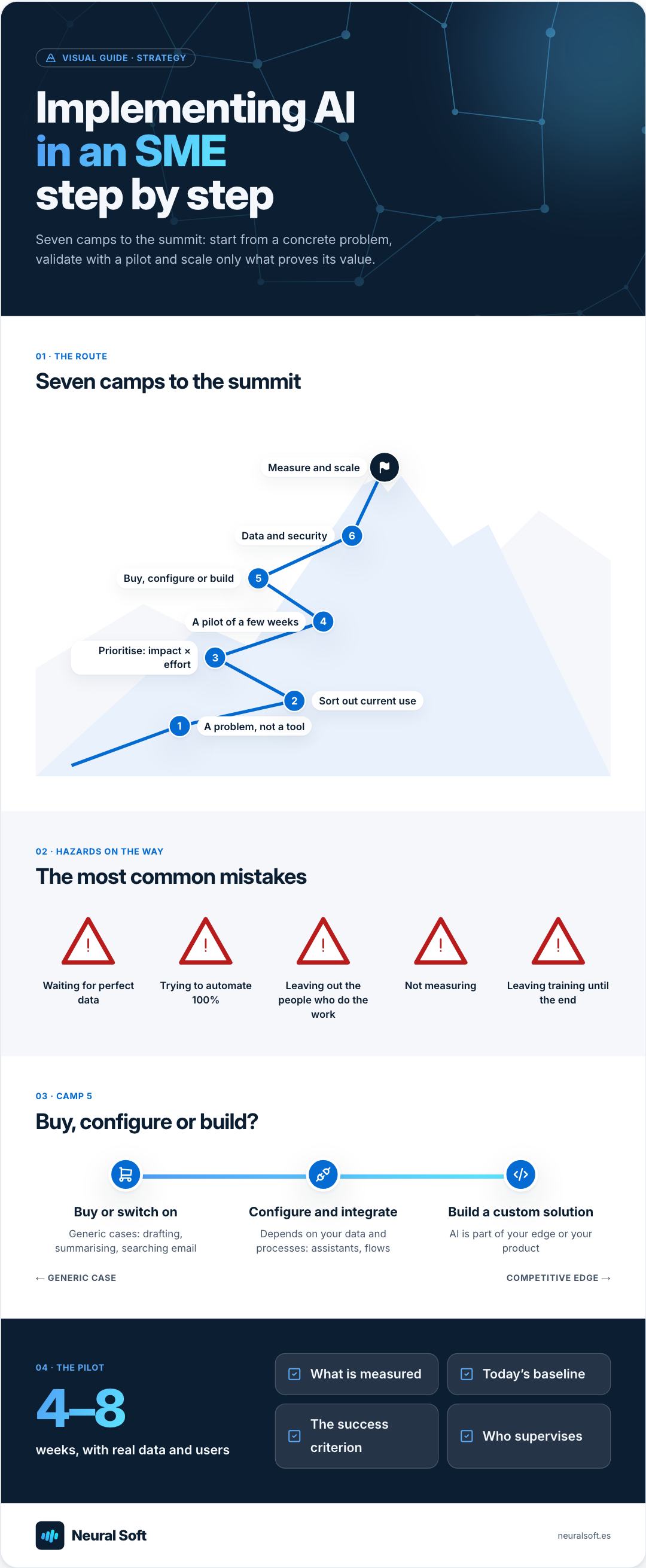
This guide sums up the method we follow in our projects: start with a specific problem, validate it with a small pilot and scale only what proves its value. Here is the route map; each stage follows in detail.
Visual guide · Strategy
Implementing AI in an SME step by step
Seven camps to the summit: start from a concrete problem, validate with a pilot and scale only what proves its value.
The most common mistake is starting with the technology (“we want a chatbot”, “we need to use agents”). It works much better to start with business questions:
Which repetitive tasks take up the most hours?
Where do errors cost money or customers?
What information gets searched for again and again?
Before launching anything new, it is worth knowing what is already happening. In most companies there are people using AI tools on their own, sometimes with customer data. Three quick actions:
Inventory: which tools are used, by whom and for what.
Usage policy: which tools are approved and which data is never entered.
Basic training: as well as reducing risks, it has been an AI Act obligation since February 2025 (we cover it in this guide to AI literacy).
3. Prioritise with an impact and effort matrix
With the list of possible cases, rate each one on two axes:
Impact: hours saved, errors avoided, revenue or customer satisfaction.
Effort: availability and quality of the data, integration with your systems, process changes and risks (personal data, decisions about people).
Impact
Start here
Plan it as a project
Quick wins, if cheap
Drop it for now
Sorting incoming emailsExtracting invoice dataDocumentation assistantCustom demand forecastingAI across the whole ERPSummarising meetingsSocial media copyVideo avatar for the website
Effort
Sorting incoming emails
Extracting invoice data
Documentation assistant
Custom demand forecasting
AI across the whole ERP
Summarising meetings
Social media copy
Video avatar for the website
An illustrative example: where each case sits depends on each company's data and processes.
The first project should come from the top-left quadrant: it has to go well, because the team’s and leadership’s confidence in everything that follows depends on it.
4. Validate with a pilot of a few weeks
A pilot is not a demo: it is a scaled-down version that works with real data and real users. For it to support a decision, define beforehand:
What is measured: time per task, percentage of cases resolved without intervention, errors, satisfaction.
The baseline: how long it takes today. Without it, there is no way to show improvement.
The success criterion: what result would justify moving to production.
Who supervises: AI makes mistakes, so the pilot must include human review.
A good pilot usually lasts four to eight weeks. If the data does not back it up after that time, that is also a good outcome: you have avoided a bigger investment.
5. Buy, configure or build
Not everything has to be custom-built. In general:
Buy or switch on what already exists (for example, Microsoft 365 Copilot or the AI features of your CRM or ERP) when the case is generic: drafting, summarising, searching email.
Configure and integrate existing tools and models when the case depends on your data and processes: an assistant with your documentation or automating a specific workflow. That is what we do in AI integration in apps and systems.
Build to measure when AI is part of your competitive advantage or of the product you sell. That is the territory of custom AI development.
When choosing, also weigh up vendor lock-in: where the data is processed, whether you can switch models and what happens if the price goes up.
6. Look after data and security from the start
Use business editions of the tools, with a data processing agreement and without your data being used to train models.
Give the AI only the permissions it needs: an internal assistant should not show an employee documents they cannot see.
Check whether the case involves decisions about people (recruitment, credit, assessment): these may be high-risk uses under the AI Act.
7. Measure, adjust and scale
If the pilot works, moving to production includes:
integrating the solution into the tools the team already uses (nobody wants yet another screen);
documenting the new process and who supervises what;
continuing to measure the impact for the first few months;
choosing the next case, building on what you have learned.
Common mistakes
Waiting for “perfect data”. Many cases work with the documentation you already have; you tidy it up along the way.
Trying to automate 100%. If AI resolves 70% of cases and a person reviews the rest, that is already a great result.
Not involving the people who do the work. The people who do the task are the ones who know where the odd cases are.
Not measuring. Without a baseline, the project depends on opinions.
Leaving training until the end. Without a team that trusts the tool, there is no adoption.
List the five tasks that take up most of your time.
If you would like help prioritising them and launching the pilot, that is exactly what our AI consulting for SMEs does.
Frequently asked questions
How much does it cost to implement AI in an SME?
It depends a lot on the case: switching on a commercial tool may cost no more than the licences, while integration with your systems is a project. That is why we recommend starting with a focused assessment and a pilot with a closed scope: the risk is small and the decision is made with data.
We help small and medium-sized businesses find where AI can add value, which cases are worth testing and how to start without investing in solutions they do not need.
We automate repetitive tasks with AI so your team spends less time copying data, reviewing documents, classifying requests or drafting replies by hand.
We design and build artificial intelligence solutions tailored to your processes, data and tools when an off-the-shelf solution does not fit or falls short.
How to choose between ChatGPT, Microsoft Copilot, Gemini and Claude for your company: criteria, data requirements and a two-week trial with real tasks.
We use Google Analytics to see which pages are visited. Its cookies are only set if you accept; if you decline, Google only receives cookieless signals. You can change this at any time from the footer. Cookie policy