Skip to content
Neural Soft

Use case

AI sales and stock forecasting

We use your sales history to anticipate demand for each product and warn you before you run out of stock or overbuy. No endless spreadsheets or gut feeling.

  • Forecasts per product, warehouse or shop, with their margin of error.
  • Takes seasons, holidays, promotions and trends into account.
  • Suggests order quantities that a person reviews and approves.
Warehouse aisle with shelves full of boxes.

The problem

Buying by eye is costly both ways

Falling short means lost sales and customers going to the competition. Overbuying means money sitting in the warehouse and products that expire or become obsolete.

Today

  • Orders are worked out from the buyer's intuition or last year's average.
  • Stock-outs are discovered once the customer has already ordered.
  • Seasons and promotions are managed from memory.
  • Planning hundreds of items takes days of spreadsheets.

With AI

  • Each item has its weekly forecast, with a confidence range.
  • Alerts arrive before the stock-out, with time to order.
  • The model learns seasonality and the effect of holidays and campaigns.
  • The purchase proposal is reviewed in minutes.

How it works

From past sales to the purchase proposal

You do not need a data science team. We start from the data your ERP or online shop already has.

  1. Data is gathered

    Sales per day and product, stock, supplier lead times, promotions and calendar.

    3 years · 850 items

  2. The model is trained

    It learns trends, seasonality and the effect of holidays and campaigns.

    Validated on real months

  3. Forecast with a range

    Expected demand per week, with a likely range, not a magic number.

    Wk 11: 280-340 units

  4. Purchase proposal

    Quantity to order based on stock, supplier lead time and safety stock.

    Order 300 units by Monday

  5. Human review

    The planner decides

    Reviews, adjusts with what they know (a trade fair, a new customer) and approves.

    Approved with +20 adjustment

Examples

Three situations forecasting solves

Seasonal product

Sales history

“Desk fans. Almost no sales in winter; peaks in June and July that vary each year with the heat.”

Forecast

Peak starts
Week 23
July demand
900-1,100 units
Recommended order
Before 15 April

Order planned around the supplier's lead time
Sales campaign

Planned promotion

“15% off replacement filters for two weeks in March, with a newsletter to customers.”

Forecast

Campaign effect
Sales ×1.8 during the promotion
Afterwards
Temporary dip for 2 weeks
Stock needed
520 units

Buyer alerted 4 weeks ahead

Many slow-moving items

Spare parts catalogue

“600 items that sell a few times a month, with irregular orders from garages.”

Forecast

Approach
Model for intermittent demand
Safety stock
Set per item
Result
Prioritised purchase list

Weekly review in 15 minutes

Data you can use

The more relevant factors, the better the forecast

  • ERP sales
  • Online shop
  • Stock and supplier lead times
  • Promotions and prices
  • Holidays and calendar
  • Weather

Feet on the ground

What to know before you start

  • History is needed

    Ideally two years or more of sales per product. You can start with less, but with more uncertainty.

  • No forecast is exact

    That is why we give a range, not a number. What matters is being more accurate than today and knowing how much margin to leave.

  • People still decide

    Buyers know things that are not in the data. The model proposes; the team adjusts and approves.

Visual guide · Sales and stock forecasting

The weather
forecast
for your sales

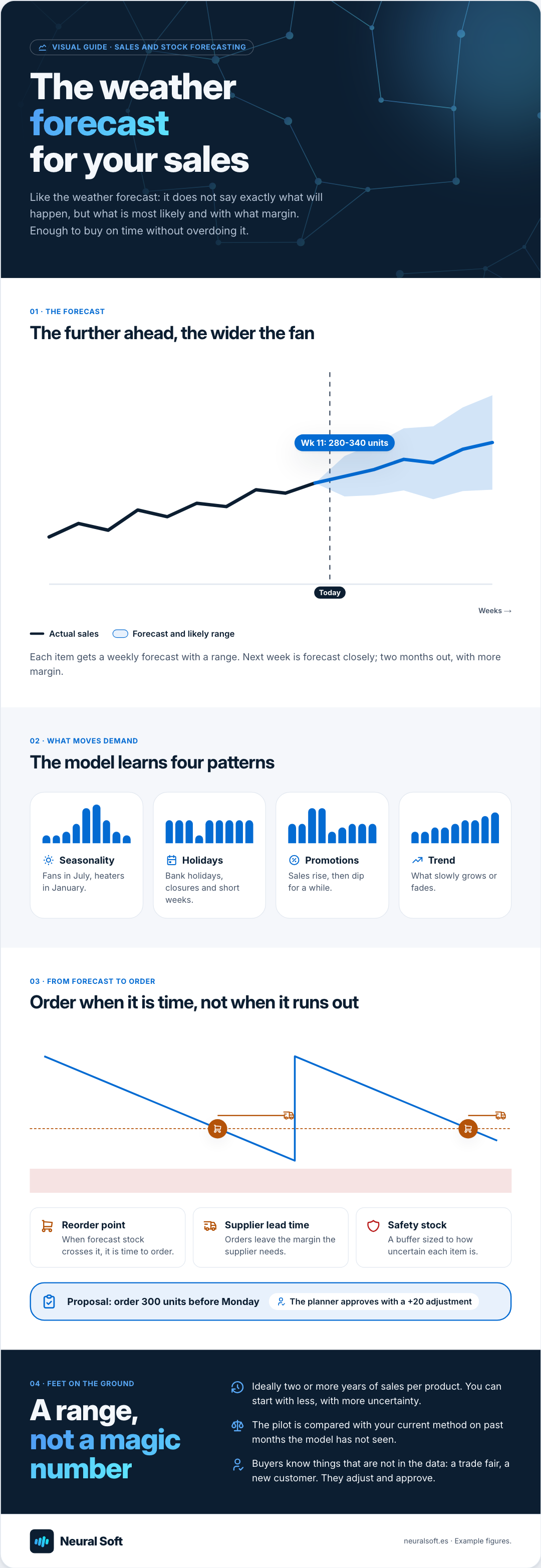
Like the weather forecast: it does not say exactly what will happen, but what is most likely and with what margin. Enough to buy on time without overdoing it.

01 · The forecast

The further ahead, the wider the fan

Actual sales Forecast and likely range

Each item gets a weekly forecast with a range. Next week is forecast closely; two months out, with more margin.

02 · What moves demand

The model learns four patterns

Seasonality

Fans in July, heaters in January.

Holidays

Bank holidays, closures and short weeks.

Promotions

Sales rise, then dip for a while.

Trend

What slowly grows or fades.

03 · From forecast to order

Order when it is time, not when it runs out

  • Reorder point When forecast stock crosses it, it is time to order.
  • Supplier lead time Orders leave the margin the supplier needs.
  • Safety stock A buffer sized to how uncertain each item is.
Proposal: order 300 units before Monday The planner approves with a +20 adjustment

04 · Feet on the ground

A range,
not a magic number

  • Ideally two or more years of sales per product. You can start with less, with more uncertainty.
  • The pilot is compared with your current method on past months the model has not seen.
  • Buyers know things that are not in the data: a trade fair, a new customer. They adjust and approve.
Neural Soft

neuralsoft.es · Example figures.

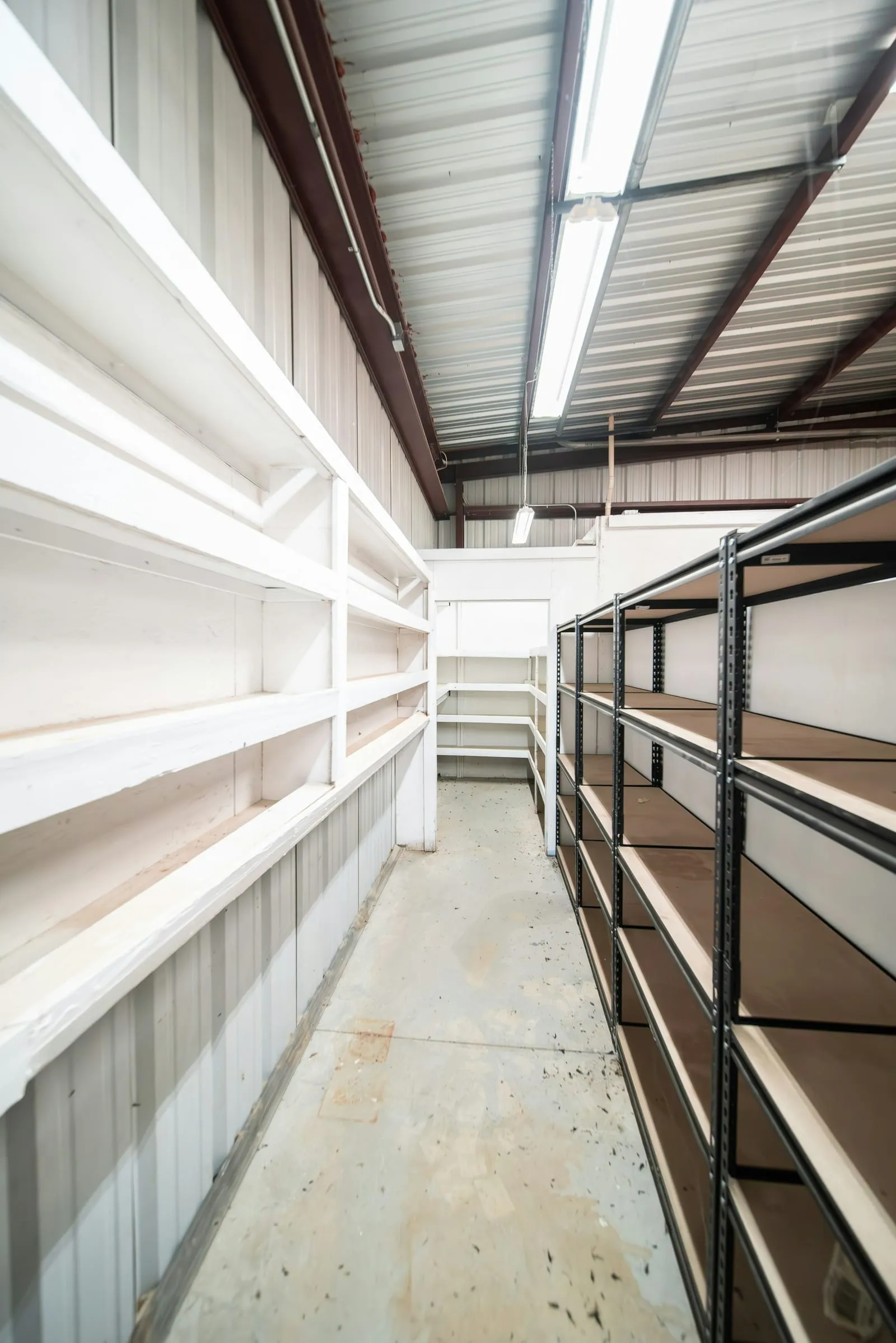
Empty shelves in a warehouse.

Alerts

Know before the shelf runs empty

The forecast turns into specific alerts: which items will run out before the next delivery and which are building up more stock than will sell.

  • Alerts with enough notice to order from the supplier.
  • A suggested quantity that the planner can change.
  • Regular checks on how accurate the forecast has been.

Method

We start by measuring whether it beats what you do today

  1. Review the data

    We check what history exists, its quality and which products account for the most money or the most stock-outs.

    Data assessment and priority items

  2. Pilot with real data

    We train the model and compare it with your current method on past months the model has not seen.

    Accuracy comparison against the current method

  3. Integrate and monitor

    We connect the forecast to the ERP or a shared sheet and review its accuracy every month.

    Weekly forecast and monitoring dashboard

Related service

  • Custom AI development

    We design and build artificial intelligence solutions tailored to your processes, data and tools when an off-the-shelf solution does not fit or falls short.

Related training

Running out of stock or with a full warehouse?

Tell us how many items you manage, where your sales data comes from and how you calculate orders today. We will tell you whether a forecasting pilot makes sense.