AI literacy: the mandatory training in Article 4 of the AI Act
What AI literacy under Article 4 of the AI Act requires, who it affects, how to document it and a role-based training plan for your company.
Session 2 of 3 · Practical AI at work
Guidelines for safe use of data
Prompts to draft and summarise
Exercise with team documents
Exercise
Summarise the latest sales report in five points and suggest two actions.
Use cases spotted
Meeting minutes Customer replies Monthly report
Neural Soft Updated 5 min read
Key points
Every company that uses AI must make sure its people know how to use it wisely. It has applied since 2 February 2025.
It does not require an official certificate or the same course for everyone; training is proportionate to each role's use.
What matters is being able to show it, with four simple documents.
Done well, it is one of the AI investments with the best return.
Of all the obligations in the EU Artificial Intelligence Act (AI Act), one affects almost every company that uses AI, whatever its size: AI literacy under Article 4. It has applied since 2 February 2025, and the postponement approved in 2026 for high-risk systems did not change its date.
In this article we explain what it requires, how to comply without red tape and how to turn it into something useful for the business.
What Article 4 says
In short, Article 4 requires providers and deployers of AI systems to take measures so that their staff, and other people operating those systems on their behalf, have a sufficient level of AI literacy.
That level is assessed according to:
each person’s technical knowledge, experience and training;
the context in which the system is used;
the people affected by its use (customers, employees, patients…).
Who does it affect?
Any company that uses AI systems in its professional activity. And that covers much more than it seems:
The whole team
Anyone using ChatGPT, Gemini, Claude or Microsoft 365 Copilot to draft or summarise.
Sales
A CRM that scores leads with AI.
Customer service
A chatbot that answers customers.
Administration
A tool that extracts data from invoices.
HR
A system that screens CVs.
External people
Freelancers or subcontractors who use those systems on your behalf.
What it does not require
To take the pressure off, it is worth being clear about what the rule does not ask for:
It does not require an official qualification or certificate. The European Commission has clarified this in its FAQs on Article 4.
It does not require the same course for everyone. Training must be proportionate to use: someone who only summarises emails does not need the same as someone who configures a system that makes decisions about customers.
It does not require everyone to become a technical expert. The point is to use AI with judgement, not to know how to train models.
What you should be able to do is demonstrate which measures you have taken: what training each role has received, which usage guidelines exist and when they were last updated.
What each role should know
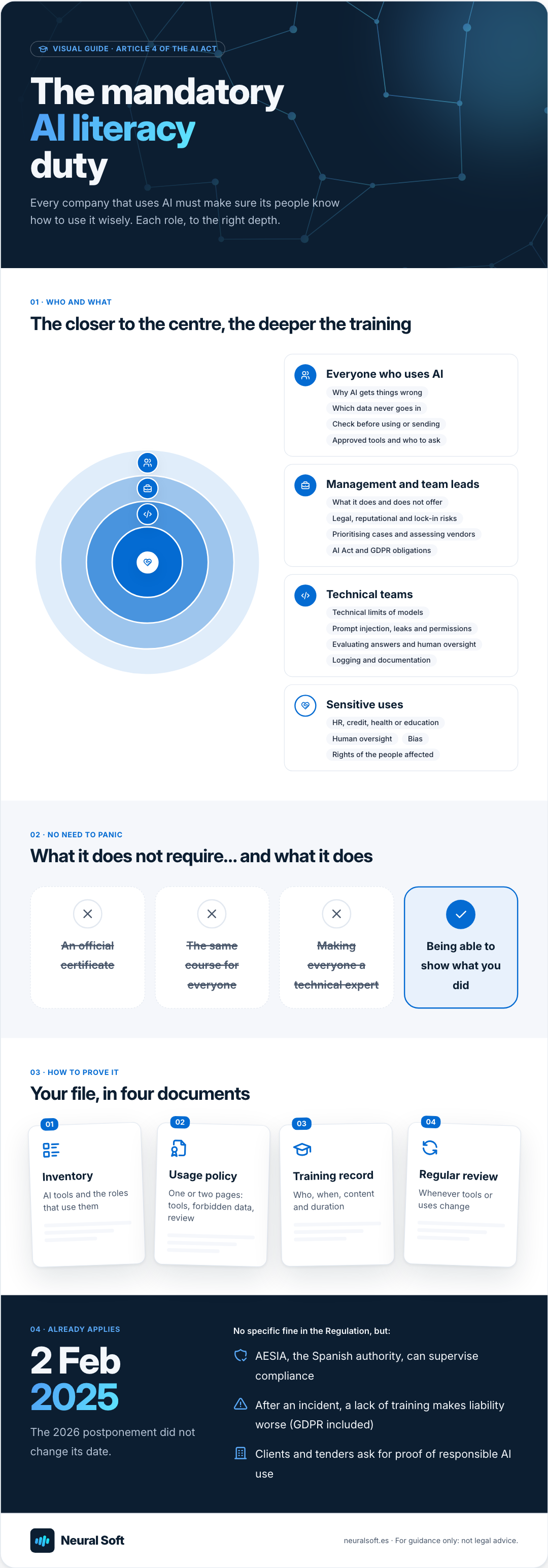
A practical way to organise it is by role: the closer someone is to decisions that affect people, the deeper their training should be. This infographic sums up the minimum content we recommend, what the rule does not require and how to show it.
Visual guide · Article 4 of the AI Act
The mandatory AI literacy duty
Every company that uses AI must make sure its people know how to use it wisely. Each role, to the right depth.
01 · Who and what
The closer to the centre, the deeper the training
Everyone who uses AIWhy AI gets things wrongWhich data never goes inCheck before using or sendingApproved tools and who to ask
Management and team leadsWhat it does and does not offerLegal, reputational and lock-in risksPrioritising cases and assessing vendorsAI Act and GDPR obligations
Technical teamsTechnical limits of modelsPrompt injection, leaks and permissionsEvaluating answers and human oversightLogging and documentation
Sensitive usesHR, credit, health or educationHuman oversightBiasRights of the people affected
02 · No need to panic
What it does not require… and what it does
An official certificate
The same course for everyone
Making everyone a technical expert
Being able to show what you did
03 · How to prove it
Your file, in four documents
01
Inventory
AI tools and the roles that use them
02
Usage policy
One or two pages: tools, forbidden data, review
03
Training record
Who, when, content and duration
04
Regular review
Whenever tools or uses change
04 · Already applies
2 Feb 2025
The 2026 postponement did not change its date.
No specific fine in the Regulation, but:
AESIA, the Spanish authority, can supervise compliance
After an incident, a lack of training makes liability worse (GDPR included)
Clients and tenders ask for proof of responsible AI use
People who use AI in HR, credit, health or education, or in decisions that affect people, need specific training on human oversight, bias and the rights of those affected. These uses may also be high-risk, with additional obligations from 2 December 2027.
How to document it without red tape
For an SME, four elements are usually enough:
Inventory of AI tools and the roles that use them.
Usage policy of one or two pages: approved tools, prohibited data and human review.
Training record: who, when, content and duration.
Periodic review: when tools or uses change, the training is updated.
Keep the evidence (attendance, materials, policy version). If there is ever an incident or an inspection, or a large customer asks you to demonstrate compliance, it will be the first thing they ask for.
What happens if you do not comply?
The Regulation does not set a specific fine for Article 4 (it leaves penalties for other breaches to each Member State), and this is one of the most frequent questions. But that does not mean there are no consequences:
market surveillance authorities (in Spain, AESIA) can supervise compliance;
if an untrained employee causes an incident (for example, leaks customer data into a public tool), the lack of measures increases the company’s liability, including under the GDPR;
more and more customers and tenders ask suppliers for evidence of responsible AI use.
From obligation to advantage
Action plan
Build the inventory of tools and roles (you can start with our AI maturity test).
For the full context of the Regulation, read our AI Act guide for SMEs. And if you would rather we organise it with you, our AI training for companies page sets out the role-based programmes.
We help small and medium-sized businesses find where AI can add value, which cases are worth testing and how to start without investing in solutions they do not need.
We use Google Analytics to see which pages are visited. Its cookies are only set if you accept; if you decline, Google only receives cookieless signals. You can change this at any time from the footer. Cookie policy