Conveyor motor
Data
“Vibration on motor M-07 has been rising slowly for three weeks, especially when the conveyor is loaded.”
Alert
- Likely diagnosis
- Bearing wear
- Estimated margin
- 2-4 weeks
Work order for Thursday's stop
Use case
Sensor data from your machines (vibration, temperature, power use) warns of wear before a breakdown. Repairs happen during a planned stop rather than in the middle of production.
The problem
Both usual approaches cost money. Predictive maintenance steps in when the data shows it is needed.
Reactive
Scheduled preventive
How it works
Vibration, temperature, power use or pressure, from existing sensors or new ones.
Every minute, 24/7
The model learns how each machine runs when it is healthy.
6 months of data
It detects deviations and known wear patterns.
Bearing vibration +35%
It suggests checking the part at the next stop, with the spare part planned.
Check on Thursday
Human review
The technician validates, plans and logs what they found, and the model learns from it.
Bearing replaced
Examples
Sample data from a fictitious plant.
Data
“Vibration on motor M-07 has been rising slowly for three weeks, especially when the conveyor is loaded.”
Alert
Work order for Thursday's stop
Data
“Pump B-3 uses more electricity to move the same flow as last month.”
Alert
Inspection on the next round
Data
“The temperature of compressor C-1 rises more than usual at start-up.”
Alert
Cooling circuit check
Data sources
In Microsoft environments, data can arrive through Azure IoT and be analysed in Fabric. We also work with existing SCADA systems and PLCs.
Down to earth
Sensors that record regularly. If there are none, you can start with one critical machine and low-cost sensors.
Knowing what failed and when helps the model recognise patterns. Without a history, we start by detecting what is out of the ordinary.
A person validates every alert. Their notes are what make the model improve.
Visual guide · Predictive maintenance
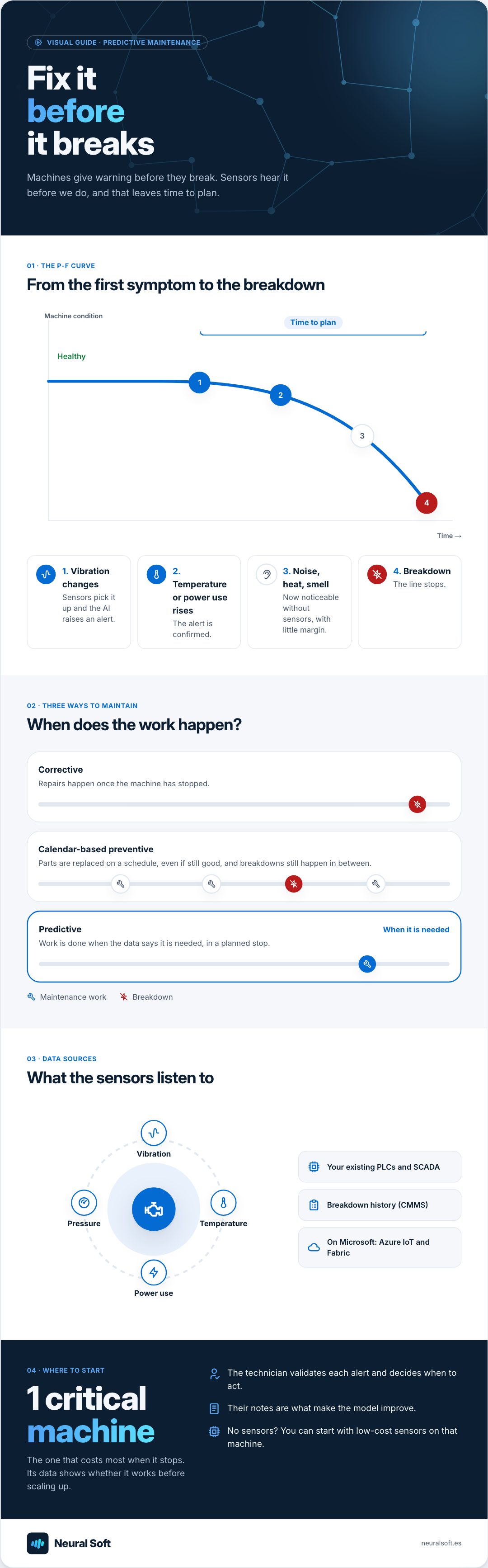
Fix it
before
it breaks
Machines give warning before they break. Sensors hear it before we do, and that leaves time to plan.
01 · The P-F curve
02 · Three ways to maintain
Corrective
Repairs happen once the machine has stopped.
Calendar-based preventive
Parts are replaced on a schedule, even if still good, and breakdowns still happen in between.
Predictive
When it is needed
Work is done when the data says it is needed, in a planned stop.
Maintenance work Breakdown
03 · Data sources
04 · Where to start
1 critical
machine
The one that costs most when it stops. Its data shows whether it works before scaling up.

Workshop
With a few weeks' notice you can order the spare part, schedule the work for a planned stop and assign the right technician, without the rush.
Method
We pick a piece of equipment whose breakdown is costly and review what data it records and what breakdown history exists.
Feasibility study with real data
We connect the data, train the normal-behaviour model and tune the alerts with the maintenance team.
Status dashboard and trial alerts
We connect the alerts to maintenance management and measure the stops avoided.
Live alerts and monthly follow-up
We design and build artificial intelligence solutions tailored to your processes, data and tools when an off-the-shelf solution does not fit or falls short.
Real predictive models, from the data to evaluation and interpretation.
Less paperwork and fewer repetitive tasks in internal processes.
Tell us which equipment is critical, what sensors it has and how you log breakdowns. We will tell you whether predictive maintenance is a good place to start.
May we measure visits?
We use Google Analytics to see which pages are visited. Its cookies are only set if you accept; if you decline, Google only receives cookieless signals. You can change this at any time from the footer. Cookie policy