What AI pays: 7 facts about jobs in artificial intelligence
AI pay by country, who hires the most, which skills pay best and how Spain compares: data from over 14,000 open technical AI jobs.
Your company with AI · today
126
Emails sorted
48
Invoices processed
312
Assistant questions
Recent activity
Martí Supplies invoice validated and sent to the ERP
Suggested reply for a quote for 40 units
Urgent issue assigned to the technical team
Time saved this week14 h
Neural Soft 3 min read
Key points
An AI intern in the US earns a median of $109,000 a year, more than the median AI job in Germany.
Accenture has more open AI jobs than OpenAI and Anthropic combined.
Knowing CUDA or distributed training is worth about $45,000 more a year in the US.
In Spain, only 8.5% of AI jobs state the pay, and there are almost twice as many remote AI jobs open to people in Spain as jobs based there.
There is plenty of talk about what AI will do to jobs. We looked at something more concrete: which AI jobs are on offer today, where and for how much. The data comes from Neural Roles, our AI jobs board, which reads the jobs published on the careers sites of thousands of companies every day.
The snapshot is from 20 November 2026: over 14,000 open technical AI and machine learning jobs worldwide. These are the seven facts that struck us most.
Data · AI jobs
What AI really pays today
Over 14,000 open technical AI jobs, read from companies’ own job boards. This is what they say.
01 · The payslip
A US intern earns more than the median in Germany
ItemMedian yearly pay
United States$205,000
United Kingdom$157,000
Canada$125,000
Intern in the US$109,000
Germany$103,000
Poland$78,000
Netherlands$78,000
France$73,000
Italy$46,000
Midpoint of the published range, in US dollars. Internships as a yearly salary.
The same AI job pays 4.4 times more in the US than in Italy.
02 · Who hires
One consultancy, more than OpenAI and Anthropic combined
Accenture
164
OpenAI + Anthropic
OpenAI 75Anthropic 65140
Open technical AI jobs. NVIDIA (146) and PwC (139) come next.
03 · What pays best
Knowing CUDA: about $45,000 more a year
$205,000
All jobs
$250,000
CUDA
Best-paid skills in the US (yearly median):
Distributed training
CUDA
Triton
All around $250,000: getting the most out of GPUs pays.
04 · Juniors
1 in 9 “junior” jobs asks for 3 years’ experience or more
43 of the 370 junior or intern jobs that state the years ask for 3 or more; some ask for 5.
05 · And in Spain
Little pay on show, plenty of remote work
8,5 %
of AI jobs in Spain state the pay, on the day the law starts to require it. In the US, 56%.
603 vs 319
remote AI jobs open to people in Spain, against the jobs based in Spain.
1. An AI intern in the US earns more than the median in Germany
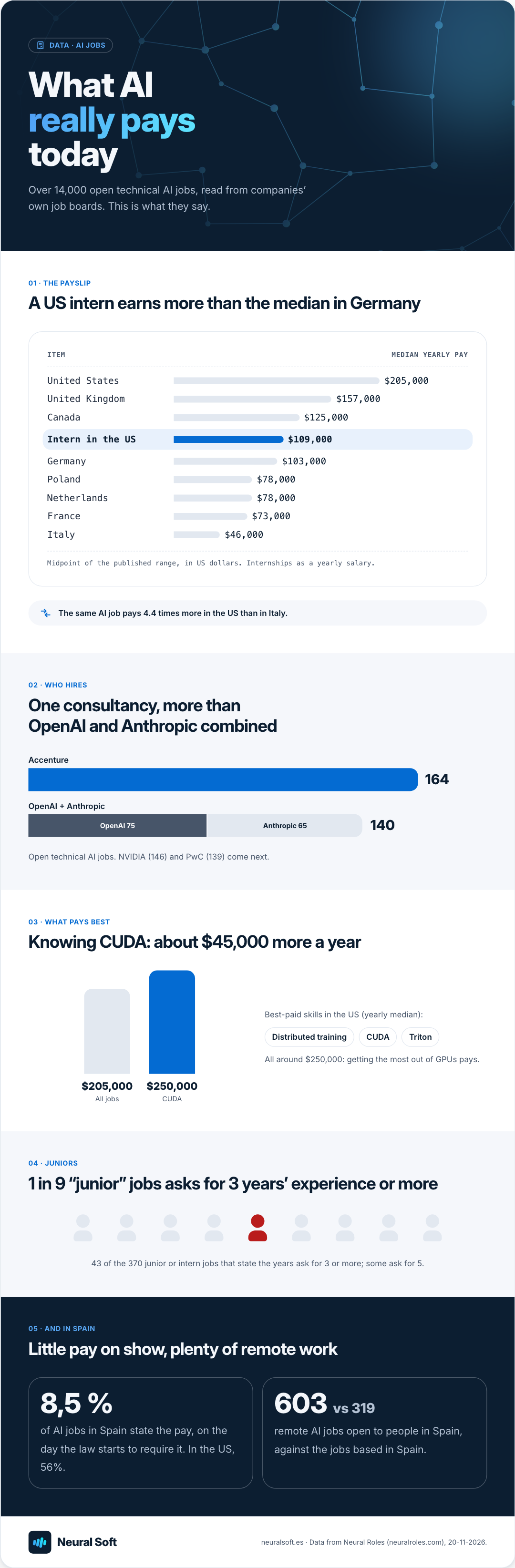
The median AI internship in the United States pays $109,000 a year. That is more than the median of all AI jobs in Germany ($103,000), Poland, the Netherlands or France.
2. The same job pays 4.4 times more in the US than in Italy
The median AI job pays $205,000 a year in the United States, $157,000 in the United Kingdom, $103,000 in Germany and $46,000 in Italy. Spain is missing because almost no job there states the pay (see point 6).
3. One consultancy has more AI jobs than OpenAI and Anthropic combined
Accenture has 164 open technical AI jobs; OpenAI has 75, and Anthropic 65. NVIDIA (146) and PwC (139) come next. AI is no longer hired only by the labs: it is hired above all by those who roll it out in other companies.
4. Knowing CUDA is worth about $45,000 more a year
In the US, AI jobs asking for distributed training, CUDA or Triton have a median of about $250,000, against $205,000 overall. The skills that squeeze the most out of GPUs, which are expensive and scarce, pay more.
5. 1 in 9 “junior” jobs asks for 3 years’ experience or more
Of the 370 junior or intern jobs that state the years of experience, 43 ask for 3 or more, and some for 5. In Spain, on top of that, only 6% of AI jobs are for juniors, against 27% in France and 20% in Germany.
6. In Spain, only 8.5% of AI jobs state the pay
Since 19 November, Royal Decree-law 39/2026 (in Spanish) requires job ads to state the starting pay. On the first day, only 8.5% of AI jobs in Spain did, against 56% in the US.
7. Almost twice as many remote AI jobs for people in Spain as jobs based there
There are 603 remote AI jobs open to people living in Spain, against 319 based in Spain. And one more, from a different kind of work: AI training pays a median of $173 an hour to people with a medical background, and $22 to those from the humanities.
What it means for a company
Talent competes with the US
An AI profile in Spain can work remotely for a foreign company. Keeping them is not only about pay: interesting projects and training count too.
Training pays off
If hiring is expensive and slow, training the team that already knows the business is often the fastest way to apply AI.
Publish the pay
It is now mandatory in Spain, and jobs with pay stand out when almost none state it.
Frequently asked questions
Where does this data come from?
From Neural Roles, our AI jobs board, which reads the jobs on the careers sites of thousands of companies every day. It covers the more than 14,000 technical AI and machine learning jobs open on 20 November 2026. It is not a survey or a sample of the whole market: it is the published jobs we gather.
How is pay calculated?
As the midpoint of the yearly range each job publishes, converted to US dollars, and the median of each group. Only jobs that publish pay count, and a country needs at least 30. Internships count as a yearly salary.
Why is there no median pay for Spain?
Because very few AI jobs in Spain publish the pay: fewer than 30 out of about 320. Since 19 November 2026 the law requires it, so we expect to give the figure in the coming months.
Can I use this data?
Yes. It is published under a CC BY 4.0 licence at neuralroles.com/en/ai-jobs-data, with a downloadable CSV: you may use it, in the press and in research too, crediting the source.
We help small and medium-sized businesses find where AI can add value, which cases are worth testing and how to start without investing in solutions they do not need.
How to choose between ChatGPT, Microsoft Copilot, Gemini and Claude for your company: criteria, data requirements and a two-week trial with real tasks.
How to implement artificial intelligence in an SME: choosing the first use case, running a pilot, buying or building, measuring the return, avoiding mistakes.
5 min read
Want to apply this in your company?
Tell us about your case and we will tell you, with no commitment, whether AI makes sense and where to start.
We use Google Analytics to see which pages are visited. Its cookies are only set if you accept; if you decline, Google only receives cookieless signals. You can change this at any time from the footer. Cookie policy